
Hingham City Directory Shelf and Coverage
The Massachusetts State Library holding list is the clearest starting inventory for Hingham directory volumes. It identifies isolated early volumes, combined Hingham and Cohasset issues, and a later run, rather than one uninterrupted series. The list also separates voting lists and the 1977 street index from resident and business directories. That distinction matters because each publication was made for a different purpose and can place a person at a different point in time.
| Collection | Years | Where Held | Access |
|---|---|---|---|
| Resident and business / town directories | 1894; 1902, 1903, 1905, 1906 | Massachusetts State Library | Confirm volume access with the holding library |
| Hingham and Cohasset directory titles | 1908-09; 1912-13; 1920 | State Library holdings and local historical references | Check town and street in every hit |
| Polk's Hingham and Cohasset Directory | 1928 | Named in Hingham Historical Commission material | Locate the specific volume before citing it |
| Later Hingham directory run | 1925-1930 | Massachusetts State Library | Verify individual issues and title pages |
| Voting lists and street index | 1924; 1936-46; 1948; 1950; 1952; 1953-58; 1980; 1988; 1977 | Massachusetts State Library | Use as a separate record series |
The State Library directory and voting-list holdings do not establish that every year between listed volumes exists. They also do not provide a definitive last printed Hingham directory year. Treat gaps as gaps, then use the Library, Town Clerk, or Historical Society to identify an alternate record rather than extending a run by assumption.
Hingham Directory Years and Gaps
An 1885 Hingham resident and business directory is known from a 90-page metadata record. Its title describes resident, street, business, town-officer, school, society, church, and post-office material. A readable individual entry and reliable publisher provenance were not available in the inspected source, so no specific line or abbreviation from that book should be quoted without first checking a scan or library copy.
For the directory period that can be documented, the useful sequence is 1885 metadata, the State Library's 1894 and early twentieth-century issues, the combined Hingham and Cohasset volumes, Polk's 1928 title, and the 1925-1930 holdings range. The later voting lists and 1977 street index extend the shelf, but they are not substitutes for those volumes.
Note: A missing year online may reflect a book, microfilm reel, or finding aid rather than proof that Hingham kept no local record.
Hingham and Cohasset Directory Caution
The shared 1908-09, 1912-13, and 1920 titles create a simple same-name trap. A surname hit in one of those volumes is not enough to call the person a Hingham resident. Confirm the town label and the street, then compare another dated source when the address or family relationship matters.
Initials, honorifics, spouse references, occupations, and surname variations can further blur a search. Use fewer letters when testing a likely spelling, record the form exactly as printed, and keep Hingham and Cohasset results in separate notes. The combined title is useful evidence, but only after the locality is checked.
Reading Hingham Directory Entries
Hingham directory material should be read as a set of expected search units, not as a standard form. The available research supports four units: a surname or name section, a street or address section, a business section, and a civic or organization section. A person may appear in more than one unit. The street section can be the stronger lead when the goal is to connect an address with a dated household.
| Name unit | A surname or personal-name listing, if the volume contains one. |
|---|---|
| Street unit | An address or street-section listing that can support a household trace. |
| Business unit | A commercial listing or address reference, when included by that title. |
| Civic unit | A town, school, society, church, or other organization listing described by the 1885 metadata. |
- Criss-cross directory
- A directory arranged by street or address rather than by surname, useful for checking a place in a given year.
- Householder index
- An index that points to the household name associated with an address or listing, when a volume supplies one.
- Abbreviation key
- The volume's own guide to its shorthand. Check it before interpreting an abbreviated line because a readable Hingham key was not available in the inspected web sources.
Do not turn a name in a directory into a claim of deed ownership, voter status, or continuous occupancy. Pair the printed wording with the publication year and the source category. That label preserves what the volume can actually show.
Hingham Digital and Desk Access
Hingham Public Library Digital Resources connects researchers to digitized local-history material, the Historic Asset Inventory, newspaper access, and an Internet Archive historical collection. The Historical Collection includes family, business, organization, school, correspondence, land-record, manuscript, pamphlet, and publication material, often in downloadable JPG or PDF form. These sources can supply a companion document when a directory year alone leaves a name or address uncertain.
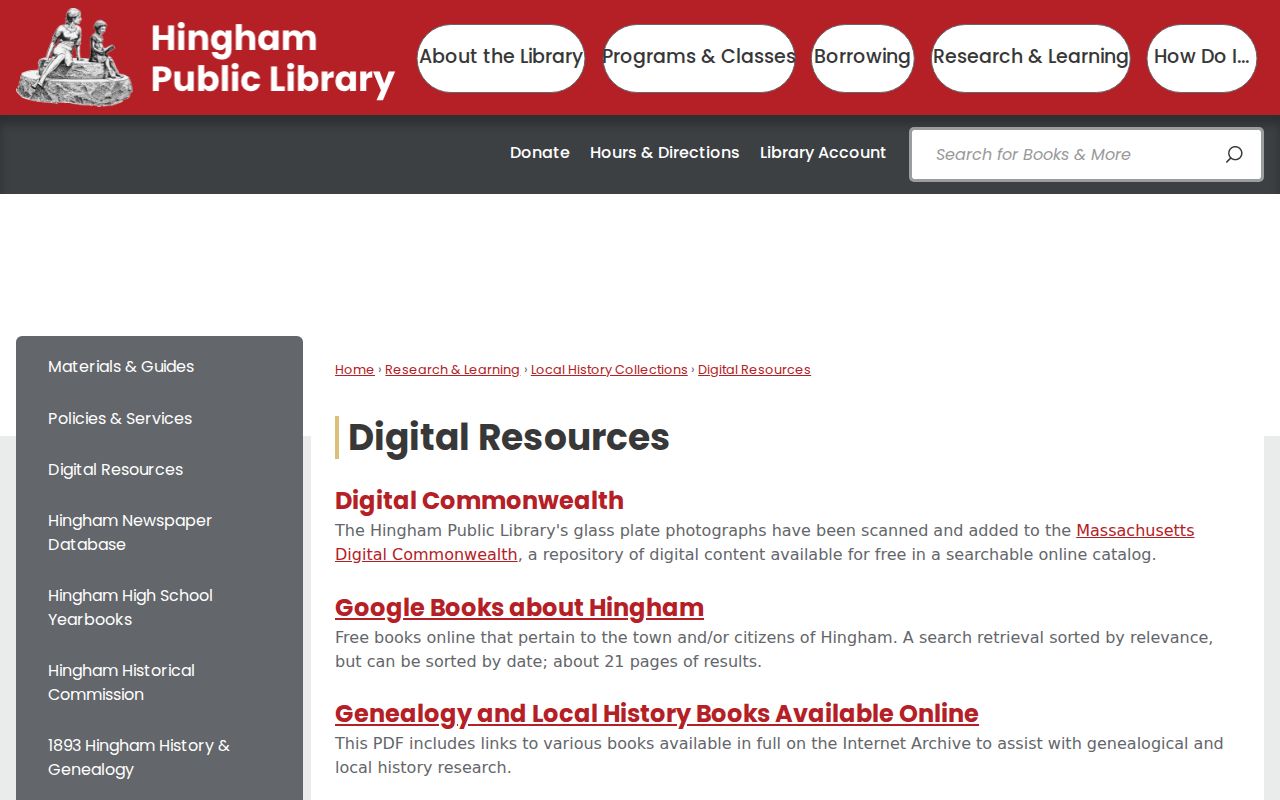
The digital-resource screen points toward a source trail, not a complete directory scan list. The Library is at 66 Leavitt Street, reachable at 781-741-1405, with Monday through Thursday hours of 10 to 9 and Saturday hours of 9 to 5. Newspaper material from 1978 onward is available at the Library, while the digitized local newspaper archive covers 1827 through 1976.
Hingham Historical Research at the Clerk
For records that are not a digital collection, the Town Clerk's historical holdings offer a local fallback. They include historic vital and business records, street lists, Town Meeting material, cemetery lot deeds, public ways, ZBA records, and wills for perpetual care of cemetery lots. Public research is by appointment at 210 Central Street, Tuesday 9 to 6:30 and Wednesday and Thursday 9 to 4. Advance notice is especially useful for election and Town Meeting records.
The Town Clerk's genealogical and historical research service also allows staff research at a distance. Onsite research has no fee. Remote vital research is $25 per surname, remote non-vital research is limited to one hour for $25, and non-vital scans or prints are 20 cents per page. A historic-record request is the documented route for describing the record and delivery needed.
Hingham Directory Newspaper Context
A directory gives a dated listing. Local newspapers can help test what happened around that date. Hingham's digitized newspaper titles include the Gazette, Patriot, Hingham Journal and South Shore Advertiser, Hingham Journal, and Spunkville Chronicle, with coverage from 1827 through 1976. Search a surname with a street, organization, or period term instead of relying on the town name alone.
Notices of a transfer, marriage, death, business opening, school activity, or Town Meeting can help distinguish two similarly named people. They remain a contextual source, not a replacement for an official record. The 1978-and-later newspaper database is a Library-access channel, so a no-result in the digitized archive is not the end of the search.
Tracing a Hingham Directory Household
Use a directory to build a dated household trail, not to fill every missing year. Start with the closest known name or address and preserve the spelling, street form, and any business or civic context exactly as printed. Then pair that record with the federal census schedule nearest in time. NARA makes schedules from 1790 through 1950 available for research, while Hingham's directory years are irregular.
- Find the surname or street unit in the nearest documented Hingham directory year and record the full source title.
- Check the companion street, business, or civic unit if the volume has one, keeping each result as a separate source role.
- Move to the next documented year and note a changed street spelling, address, or organization before inferring a move.
- Pair the directory date with the closest NARA federal census schedule and compare the household as of that enumeration date.
- Use a newspaper, cemetery, vital, or deed record to test a change, then return to the next available directory volume.
A disappearance may reflect a move, death, an editorial choice, a name variation, or a gap in the surviving run. Census, street-list, deed, and newspaper dates can narrow the explanation. The results should remain labeled as directory appearance, census household, deed party, or other specific relationship rather than being collapsed into one claim.
Hingham House-History Leads
Hingham's Historic Asset Inventory is arranged alphabetically by street and records a construction date, architectural style, original resident, map or lot information, and MHC documentation. It can turn a city-directory address into a research lead without deciding the legal ownership question. The Hingham Historical Society adds more than 150 Julian Loring notebooks on nearly every historic house, plus family papers, photographs, oral histories, and other local collections.
The Historical Society collections and archives describe 15,000 database records, with at least half again not yet in PastPerfect. Archives visits are by appointment Tuesday, Thursday, or Saturday from 1:30 to 4. Start with the directory's address or surname, then ask for the related finding aid instead of assuming that a house notebook proves a particular resident or deed party.
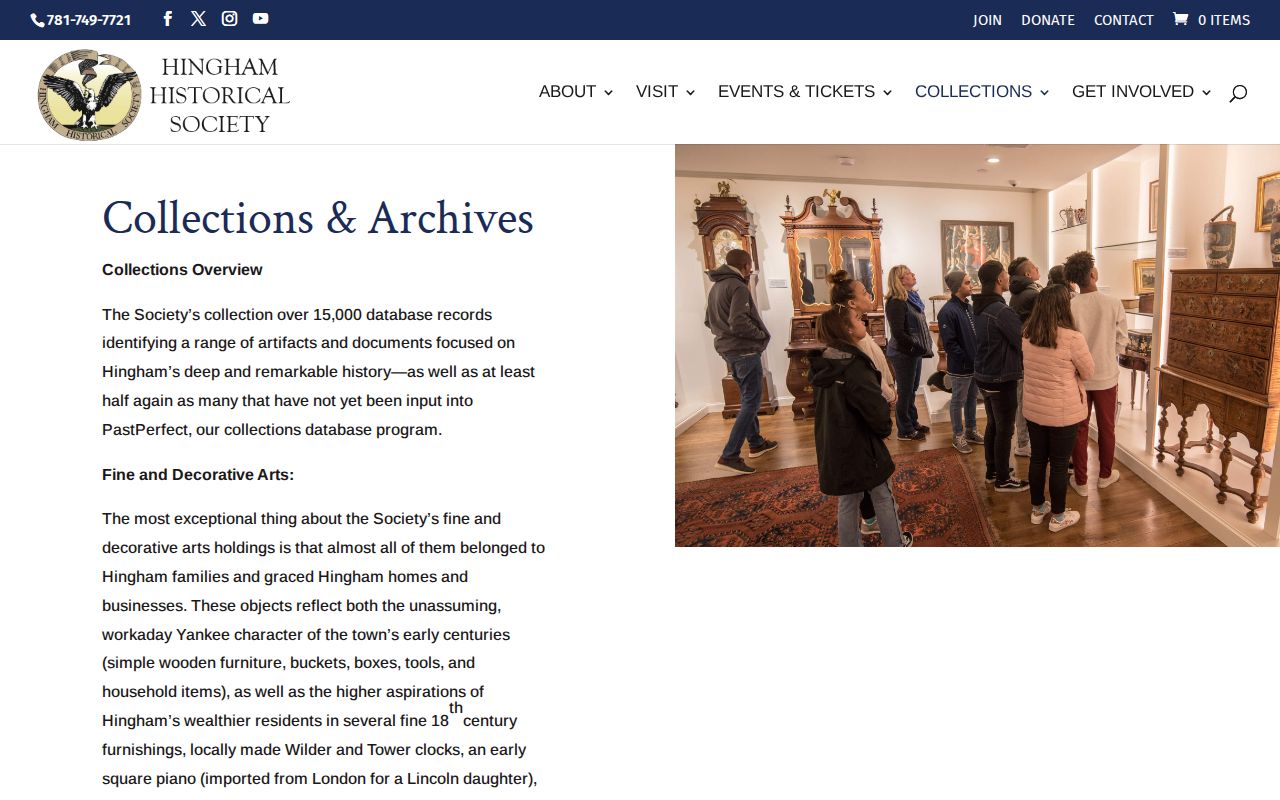
The archive page is a practical bridge between a printed listing and a deeper local collection. It also makes clear why an appointment and a finding-aid request can be more useful than a broad name-only search.
Hingham Directory Limits and Next Steps
Directories, voting lists, annual street lists, taxpayer lists, and census schedules have distinct inclusion rules. A person can appear in one and not another without a contradiction. The 2009 preservation assessment also noted uncertain scope for some Library-vault Town Records microfilm, so a catalog or staff confirmation is important before treating a missing reel as a missing record.
Use the town, street, and publication date to keep a Hingham search narrow. For old Harbor references, try Town Street as well as North Street and Broad Cove Lane as well as Lincoln Street. Period terms such as cordage, the shipyard, silk tassels, or the Hingham Bucket can help locate a business or community reference in the newspaper and Historical Society collections.
Note: A Hingham city directory supports family and place research, but it does not establish a current address or permission to contact anyone.